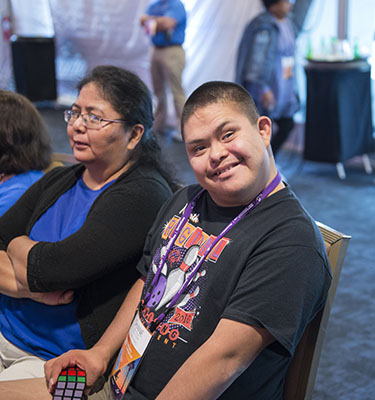
Our Sexual Assault Response Trainer and Crime Victim Advocate specializes in supporting individuals with intellectual and developmental disabilities (I/DD). She provides trauma-informed training to law enforcement, hospital staff, therapists, and community organizations to improve response, accessibility, and care for survivors with I/DD. She is passionate about ensuring that every survivor feels valued and understood. She works hard to provide the right support and care they need, making certain they are treated with dignity and kindness throughout their journey across different systems.
https://arcnm.org/wp-content/uploads/2019/08/ArcLogo_CMYKColor_Pos.png400375Mikehttps://arcnm.org/wp-content/uploads/2022/08/Arc_NewMexico_Color_Rev_PNG_croped-removebg-preview-1-300x153.pngMike2025-06-10 14:44:142025-06-10 14:44:14Our Sexual Assault Response Trainer and Crime Victim Advocate specializes in supporting individuals with intellectual and developmental disabilities (I/DD)
The Arc of New Mexico acts as administrators through our Self-Advocacy program. The program is funded through grants, which are utilized to pay advocates for their work on various leadership projects. Participants must be enrolled in a state program, such as the DD waiver. The advocates mentor other upcoming advocates as they help facilitate trainings and programs. Participants submit time sheets for their work, which includes preparation and presentation time. One of the primary focuses of the program is to develop leadership skills as advocates gain experience and in turn uplift others, teaching the personal and practical skills needed to organize and facilitate meetings and activities.
https://arcnm.org/wp-content/uploads/2019/08/ArcLogo_CMYKColor_Pos.png400375Mikehttps://arcnm.org/wp-content/uploads/2022/08/Arc_NewMexico_Color_Rev_PNG_croped-removebg-preview-1-300x153.pngMike2025-06-10 14:42:522025-06-10 14:42:52The Arc of New Mexico acts as administrators through our Self-Advocacy program
In 2025, New Mexico became the 28th state to pass a bill recognizing Supported Decision Making as a legal alternative or addition to guardianship. Supported Decision Making creates more independence and provides protected persons greater discretion over their lifestyle in matters such as housing, medical care, finances, and day-to-day personal choices. It makes I/DD clients better self-advocates, and can relieve those who assist them of fiduciary duties. The documentation putting Supportive Decision Making in place also makes life easier for everyone involved by specifying the parameters of support based on those which the individual has requested, and those which are retained within guardianship. It represents an improved quality of life for New Mexicans with disabilities, and a more dynamic and compassionate approach to care, empowering the people it serves, and those who provide them services.
https://arcnm.org/wp-content/uploads/2019/08/ArcLogo_CMYKColor_Pos.png400375Mikehttps://arcnm.org/wp-content/uploads/2022/08/Arc_NewMexico_Color_Rev_PNG_croped-removebg-preview-1-300x153.pngMike2025-06-10 14:41:152025-06-10 14:41:15In 2025, New Mexico became the 28th state to pass a bill recognizing Supported Decision Making as a legal alternative or addition to guardianship.
This Valentine’s Day, as many as 6 million couples will choose to celebrate their love by becoming engaged. But for many people with IDD, this dream of marriage forces them to choose between love and necessary supports to live independently.
When Jen Met Eddie…
Jen and Eddie at an advocacy event.
Eddie and Jen first met while planning an Oregon self-advocacy event in 2006. They both noticed each other across a table and shared with friends that they thought the other was cute. Eventually, Eddie and Jen started getting lunch together and going out – and decided to become girlfriend and boyfriend.
At lunch one day, Eddie popped the question for the first time to Jen. She asked him to come to Christmas with her and ask for her parents’ permission. At Christmas, Eddie popped the question again. “I got on one knee and asked her hand in marriage. It was quite nice.”
Both Eddie and Jen are long-time professional self-advocates and knew of the Social Security and Supplemental Security Income (SSI) marriage penalties. The marriage penalties are punitive rules that cut benefits and limit savings for married couples who rely on critical Social Security SSI benefits.
While they wanted to get married, Eddie and Jen were terrified of what getting married would mean for their lives.
Jen, who has a spinal condition that requires 24-hour medical assistance, explains, “I would lose my Medicaid and have to pay out of pocket for medical needs, and I don’t earn enough to pay out-of-pocket for medications or other medical equipment.”
Eddie, who lives in an adult foster home, adds, “It would impact me significantly if I lost my benefits. I would have no money to live on…. I would have no place to live, [as the rental costs in my county are very high].”
In the end, Jen and Eddie decided not to pursue a legal marriage—and this has meant giving up dreams, big and small.
Both Eddie and Jen wanted to foster a child and become parents, and they believed that they would be great parents to a little boy or girl. However, without a legal marriage, this dream seemed far away. Now in their late 40s, they are not sure if it could ever happen.
And, while Eddie and Jen are committed to each other, not having a legal marriage means not having the legal backing to make medical decisions for each other if needed. According to Jen, “we’d like to [be able to] make medical decisions for our partner.” But, without the legal standing, Eddie and Jen may not be able to do this.
For the past several years, Eddie and Jen have been advocating to remove this unjust rule that no couple should have to deal with.
“It’s an unfair [rule] that has been around forever. We should be able to [get married and not worry about our benefits], just like everyone else. People don’t understand that people with disabilities are just like everyone else. We pay taxes, we work, [and] we contribute to society.”
Jen and Eddie’s story is one of many. Married people with disabilities often experience penalties that force the couple to give up necessary benefits to marry. This may mean taking a pay cut, working less, or having to quit a job altogether.
No one should have to decide between being legally married and getting the support they need to live in the community.
https://arcnm.org/wp-content/uploads/2019/08/ArcLogo_CMYKColor_Pos.png400375https://arcnm.org/wp-content/uploads/2022/08/Arc_NewMexico_Color_Rev_PNG_croped-removebg-preview-1-300x153.png2021-02-12 11:24:082021-05-13 12:46:52When People With Disabilities Are Forced to Choose Between Love and Needed Benefits: Marriage Penalties
The Arc of the United States and Comcast NBCUniversal today
announced a three-year renewal of their national partnership to expand digital
technology opportunities for people with intellectual and developmental
disabilities (IDD). Comcast NBCUniversal is providing $400,000 to The Arc’s Tech
Coaching Centers, which operate their national digital literacy program, as
well as chapters that have been negatively impacted by the COVID-19 pandemic.
“We are immensely grateful for Comcast NBCUniversal’s continued
support for individuals with intellectual and developmental disabilities and
their families, and the work we do to protect their human rights and support
their participation in society,” said Peter Berns, CEO of The Arc. “Many of our
chapters have been hit incredibly hard during the COVID-19 pandemic. We are
truly fortunate to have such a longstanding and steadfast partner in Comcast
NBCUniversal in our work to support our chapters and expand access to digital
technology that will open up doors online and offline for people with
disabilities.”
The Arc’s national network of more than 600 chapters provide vital resources and services to individuals with IDD and their families to promote greater independence and opportunity in the community. With the support of Comcast NBCUniversal, The Arc will continue the important work of connecting its clients with digital skills to enhance their paths to independence through digital literacy training and financial support. Since 2017, more than 1,800 clients have received basic digital skills training at 16 sites around the country. Additionally, for the next year, Comcast will help fund general operating costs for some chapters of The Arc that face financial challenges as a result of the pandemic.
“Through the Tech Coaching Centers and our long-standing
partnership with The Arc, we’ve witnessed so many examples of individuals gaining
employment, learning digital skills, navigating the internet, and more,” said
Dalila Wilson-Scott, EVP & Chief Diversity Officer, Comcast Corporation.
“We believe it is vital to continue supporting these efforts to help create economic
mobility for people with disabilities.”
About Comcast Corporation
Comcast Corporation (Nasdaq: CMCSA) is a global media and
technology company with three primary businesses: Comcast Cable, NBCUniversal, and Sky. Comcast Cable is one of the United States’
largest video, high-speed internet, and phone providers to residential
customers under the Xfinity brand, and also provides these services to
businesses. It also provides wireless
and security and automation services to residential customers under the Xfinity
brand. NBCUniversal is global and
operates news, entertainment and sports cable networks, the NBC and Telemundo
broadcast networks, television production operations, television station
groups, Universal Pictures, and Universal Parks and Resorts. Sky is one of Europe’s leading media and
entertainment companies, connecting customers to a broad range of video content
through its pay television services. It
also provides communications services, including residential high-speed
internet, phone, and wireless services.
Sky operates the Sky News broadcast network and sports and entertainment
networks, produces original content, and has exclusive content rights. Visit www.comcastcorporation.com for more
information.
https://arcnm.org/wp-content/uploads/2019/08/ArcLogo_CMYKColor_Pos.png400375https://arcnm.org/wp-content/uploads/2022/08/Arc_NewMexico_Color_Rev_PNG_croped-removebg-preview-1-300x153.png2020-10-07 14:07:412020-11-03 08:29:52Comcast NBCUniversal and The Arc Team up to Support Local Disability Agencies and Digital Literacy for People With Disabilities
By: Nicole Jorwic, Senior Director of Public Policy, The Arc
After being all but ignored in the first three legislative packages that Congress has passed to address the COVID-19 pandemic, the disability community must rise up. We are once again fighting for our lives in Congressional negotiations—this time during a global pandemic. And the outcome will impact the services people with disabilities rely on, severely strain systems that provide those services, and may close down service providers all over the country that support people with disabilities to live the lives they choose.
This is far from the first time in my five years in Washington, DC, that I have watched Congress overlook the disability community. In 2017, the year Congress tried again and again to cut funding to Medicaid, a program that people with disabilities rely on for supports and services, we made them pay attention. But it took people with disabilities and their families coming forward to share their most personal stories, and some literally putting their bodies on the line, to show Congress that Medicaid means life and death. Together we were strong enough to hold off the full repeal of the Affordable Care Act, protect the integrity of the Medicaid program, and show the power of our community.
And, again, it seems the issues that matter to the disability community are being ignored. Our chapter network is on the front line of this pandemic: some of the people with disabilities they serve have passed away from COVID-19, and others don’t have the supplies for staff to safely serve or quarantine. The direct support professional, or DSP, staff often help people with disabilities with very personal tasks that can’t be done from six feet away, yet the personal protective equipment (PPE) necessary to do these tasks safely is scarce. And in the coming weeks and months, we know that some service providers will be forced to close, leaving families like mine with nowhere to go.
But the fight to save Medicaid in 2017 showed that when we band together as one voice, we can make things happen.
Despite the magnitude of what we are facing as a country, this is the time we must once again share our stories. We must demand that Congress address the needs of the disability community in legislation to combat COVID-19.
Here is what Congress MUST do to support the disability community:
Funding for a Medicaid grant program to support access to home and community-based services (to minimize the risk of people with disabilities being forced into institutions) and to support the DSP workforce. Congress should pass the Coronavirus Relief for Seniors and People with Disabilities Act.
Personal protective equipment (PPE) for direct support professionals. This is urgently needed to protect the health and safety of this critical workforce. Direct support professionals must be designated as essential workforce so that they have access to the PPE and medical supplies they need.
Paid leave for caregivers. As more people with disabilities lose their usual sources of care, family caregivers are scrambling and need access to paid leave and sick days to help their loved ones. Congress should include all family caregivers in the emergency paid leave provisions.
Help for people on Supplemental Security Income (SSI) to access Recovery Rebates. People with disabilities on SSI are being asked to file needless paperwork in order to access economic stimulus payments. Congress should tell Federal agencies to use their existing authority to share data and file for people on SSI.
The asks of the disability community around this crisis are simple: recognize that whether it is individuals with disabilities, their family members, or the DSP workforce, #WeAreEssential.
https://arcnm.org/wp-content/uploads/2020/03/CapitolBuilding-blog-image.png400375https://arcnm.org/wp-content/uploads/2022/08/Arc_NewMexico_Color_Rev_PNG_croped-removebg-preview-1-300x153.png2020-04-02 11:45:122020-04-02 11:50:01The Disability Community Must Once Again Show #WeAreEssential
https://arcnm.org/wp-content/uploads/2019/09/Image-for-Medical-Deferments-Response.jpg400375https://arcnm.org/wp-content/uploads/2022/08/Arc_NewMexico_Color_Rev_PNG_croped-removebg-preview-1-300x153.png2019-10-30 14:16:212019-10-30 14:16:22Read Our Blogs on Sexual Violence
Our community of Midland, Michigan, is a community that works hard to create inclusive opportunities for everyone. This past January, The Arc of Midland received a grant to organize and execute our first MLK Day of Service project. With the help of over 175 volunteers, we packaged and delivered food to over 1,000 people on one of the coldest days of the year.
The 175+ volunteers braved the cold to help direct traffic and deliver food. One man, Tom, came to receive food and ended up volunteering the entire day!
“I had no intentions of staying to help, but once I saw everyone working together to help people like me, I had to stay and be a part of giving back to the community that was giving to me.”
The Arc of Midland is lucky to be widely supported by many businesses, clubs, and organizations in our community that pitched in on this effort. The Great Lakes Loons (a local Minor League Baseball team) played host to the chapter’s Day of Service event. Not only does the team provide a safe, accessible, and welcoming environment for everyone to enjoy, but they also employ many people with disabilities throughout the year.
Another crucial partner was Hidden Harvest. Since 2016, we have partnered together through a variety of programs and projects—including a free pantry stocked weekly and supporting the community together when a fire ravaged an apartment complex where many people with disabilities and seniors lived. During this year’s MLK Day event, they provided food assistance, transportation, volunteers, and logistics for packaging of the food.
The Arc of Midland’s MLK Day work brought thousands of people together in service to build a stronger community. Together, every partnering organization, volunteer, and person receiving assistance honored Martin Luther King Jr. and his vision of belonging.
https://arcnm.org/wp-content/uploads/2019/09/R.-Baker.jpg400375https://arcnm.org/wp-content/uploads/2022/08/Arc_NewMexico_Color_Rev_PNG_croped-removebg-preview-1-300x153.png2019-09-20 12:07:242020-01-30 11:18:47The Power of Belonging: A Community Comes Together
In 2019, 37 states still have institutions where people with intellectual and developmental (I/DD) live away from their families and communities. Some may recall the horrible investigative reports over the last few decades that showed the terrible conditions in institutions, but many people fail to realize the facilities still exist and that state and federal dollars are still funding them. The Arc of the United States was founded by families trying to eliminate the need for those institutions and to get their family members with disabilities back home and included in their communities. While we have come a long way, there remains much to be done from state capitals to our nation’s capital.
The Arc developed this video to highlight the issue and to educate the general public about institutions, and to urge action to close the remaining institutions and support people with disabilities, no matter their level of need, back into the community.
At The Arc we also understand that it is more important than ever that we educate the general public about why inclusion and acceptance matters and that they join the fight to ensure that the progress that we have made as a disability community is not stalled.
We have to talk about the fact that institutions remain open, and how those dollars would be better spent in the community. We have to educate the general public about how Medicaid makes life in the community possible. We have to protect Medicaid from threats of cuts and caps that would drastically hurt people with I/DD.
To illustrate community living, check out our new video.
On the policy front, we have to talk to state and federal legislators about the fact that the federal Medicaid law that we fought so hard to save just a few years ago needs a face lift. Right now, services in institutions, nursing homes and other more segregated settings are mandatory while home and community-based services (HCBS) are optional under the law.
These are complex issues, but the basic fact remains everybody benefits when people with disabilities are part of the fabric of their communities. That doesn’t come by keeping people locked away in institutions – it comes through conversation, inclusion and acceptance that we are all better together.
https://arcnm.org/wp-content/uploads/2019/08/ArcLogo_CMYKColor_Pos.png400375https://arcnm.org/wp-content/uploads/2022/08/Arc_NewMexico_Color_Rev_PNG_croped-removebg-preview-1-300x153.png2019-09-06 12:41:302020-06-12 10:23:41New Videos From The Arc Spotlight Need to Close Institutions, Support Community Living
https://arcnm.org/wp-content/uploads/2019/07/10-Contact.jpg400375https://arcnm.org/wp-content/uploads/2022/08/Arc_NewMexico_Color_Rev_PNG_croped-removebg-preview-1-300x153.png2019-07-23 12:28:462019-08-02 13:36:30About Us